Useful articles
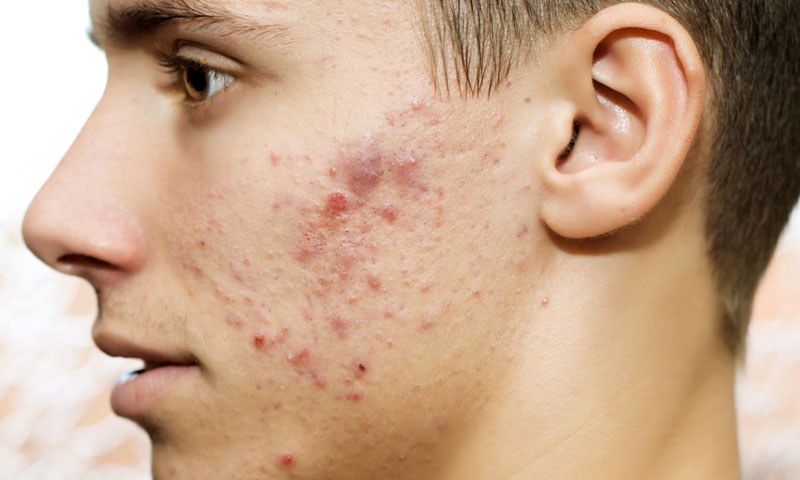
Acne and Post-Acne Scars: Treatment That Works
Acne is treated as an expected visitor of the teenage years, yet in practice people arrive at the dermatologist with the same complaint at 25, at 30 and even at 40. There is another widespread misconception: many assume acne is a matter of cleanliness. In reality it is a condition tied to how the oil glands work, and washing will not solve it.
How spots form
Four factors take part in the process:
- The oil glands start producing excess sebum;
- Dead cells build up in the wall of the pore and block it — this is where blackheads and whiteheads come from;
- The blocked pore becomes a favourable environment for bacteria to multiply;
- Inflammation begins — hence the red spots and pustules.
Treatment is therefore never one-sided: the doctor selects the approach according to which link in this chain dominates.
Severity and treatment stages
A dermatologist first assesses the type and extent of the breakout — treatment follows directly from that.
- Mild — mainly blackheads and whiteheads with a few non-inflamed spots. Correctly chosen topical products and skincare are often enough.
- Moderate — inflamed red spots and pustules are noticeable. Topical treatment is intensified and the doctor may add further options.
- Severe — deep painful nodules, widespread breakouts, scars beginning to form. This requires dermatological supervision, and systemic treatment is considered.
In every case, treatment works slowly: the first noticeable improvement usually appears after 6–8 weeks, and the full effect takes several months. So concluding "I used it for a week and it does not work" is both premature and wrong.
The names and amounts of medicines are determined by the doctor alone, taking into account skin type, age, pregnancy and interactions with other medication.
Why squeezing leaves marks
This is the most practical part of the article. When a spot is squeezed with the fingers, its contents more often travel not outward but deeper, into the layers of the skin. The area of inflammation widens, the structural framework of the skin is damaged, and a depressed (atrophic) scar is left behind.
Post-acne scarring, in other words, is often the result not of acne itself but of interfering with it. A single inflamed spot that heals on its own usually leaves nothing; a squeezed one does.
Types of post-acne marks
- Dark spots — post-inflammatory pigmentation. The good news: these are not scars and fade on their own over months. Sun protection speeds that up.
- Red-pink marks — traces of dilated small vessels, which also resolve with time.
- Depressed (atrophic) scars — genuine loss of skin tissue. These do not disappear on their own and are addressed separately.
The order matters: work on scars begins only after active breakouts have settled. Treating marks while inflammation continues simply produces new marks.
When women need hormone testing
Hormone tests are not required for every case of acne. But a dermatologist will recommend a gynecology or endocrinology assessment when these features are present:
- Spots are concentrated on the chin, along the jawline and on the neck;
- Adult acne — appearing for the first time after 25, or worsening sharply;
- Irregular periods or long delays between them;
- Excess hair growth on the face and body;
- Hair loss or unexplained weight gain has joined in;
- No response to properly chosen treatment.
In such situations hormone levels and the possibility of polycystic ovary syndrome are usually assessed. The extent of testing is decided by the doctor.
Everyday skincare rules
- Wash twice a day with a gentle cleanser — frequent, harsh washing dries the skin and drives oil production up;
- Avoid alcohol-based toners and abrasive scrubs;
- Oily skin needs moisturiser too — one labelled as non-comedogenic;
- Use sun protection: most acne treatments increase skin sensitivity, and sunlight darkens marks;
- Do not stack several "strong" products at once — this usually ends in irritated skin;
- Break the habit of touching your face.
At Doctor Hasan Medical Center
In our centre a dermatologist assesses the skin, builds a treatment plan matched to the severity of the acne and, where needed, arranges shared follow-up with an endocrinologist and a gynecologist. If breakouts have dragged on for years or have started leaving marks, it is worth stopping the self-directed experiments and seeing a specialist — results come sooner than people expect.
For teenagers and parents
For a teenager acne is usually not a cosmetic problem but a social one: it affects behaviour, friendships and mood at school. So the line "everyone gets it at your age, it will pass" does not help — it dismisses the complaint.
What actually works:
- Starting treatment earlier — the most reliable way to reduce the chance of scarring;
- Explaining the plan to the teenager directly: understanding why results take 6–8 weeks stops them abandoning treatment halfway;
- Keeping skincare simple — a two or three step routine gets done daily, while an elaborate ten-step one does not get done at all;
- Not hunting for a culprit in the diet: chocolate is not the main cause of acne.
If spots have started leaving marks or are noticeably affecting mood, do not put off seeing a dermatologist.
Important: this article is for information only and does not replace a medical consultation. See a specialist for an accurate diagnosis and treatment plan.
Our doctors in this field